Cash-Out Refinancing for Debt Consolidation: Benefits, Costs, and Considerations
Oct 28, 2026Financial Coaching
None of the examples in this article are a rate offer. Mortgage payments exclude property taxes, homeowners insurance, and any mortgage insurance. Credit card payment formulas vary by issuer. Actual rates, costs, and eligibility vary. Debt consolidation does not reduce the principal amount owed and may not reduce the total cost of borrowing.
If you’ve locked in a low mortgage rate, the thought of refinancing at a higher rate might seem counterintuitive. But what if your mortgage isn’t the only debt affecting your monthly budget?
It’s a fair question. A low mortgage rate is valuable. But credit card balances, auto loans, and other financial obligations can add up quickly. Even with a great mortgage rate, juggling multiple payments, especially on higher interest debts, can make it harder to save, cover everyday expenses, or prepare for the unexpected.
That’s where a cash-out refinance may be worth exploring. By using a portion of your home equity to consolidate certain debts, you may be able to simplify your payments and create more room in your monthly budget.
What is a Cash-Out Refinance
A cash-out refinance replaces your existing mortgage with a new, larger mortgage. After paying off your original loan and applicable closing costs, you receive the remaining proceeds as cash.
That money can be used for a variety of purposes, including paying off high-interest credit card balances, consolidating auto loans, or covering other major expenses.
Unlike a home equity loan or home equity line of credit (HELOC), which generally allows you to borrow against your home while keeping your existing mortgage, a cash-out refinance replaces your current mortgage with a new one.
This distinction matters, particularly if you already have a low interest rate. Refinancing could change your mortgage rate, monthly payment, and repayment timeline, so it’s important to weigh the potential benefits against the costs.
How Refinancing Can Lower Your Monthly Payments
A consolidation cash-out refinance can use home equity to consolidate debt. A new mortgage replaces your existing loan, with additional proceeds applied toward credit cards, auto loans, or other obligations.
Depending on your existing debts, loan terms, and interest rate, combining your debts into a new mortgage could reduce your total monthly payments, even if the new mortgage payment is higher than your current mortgage payment.
Consider the following hypothetical example:
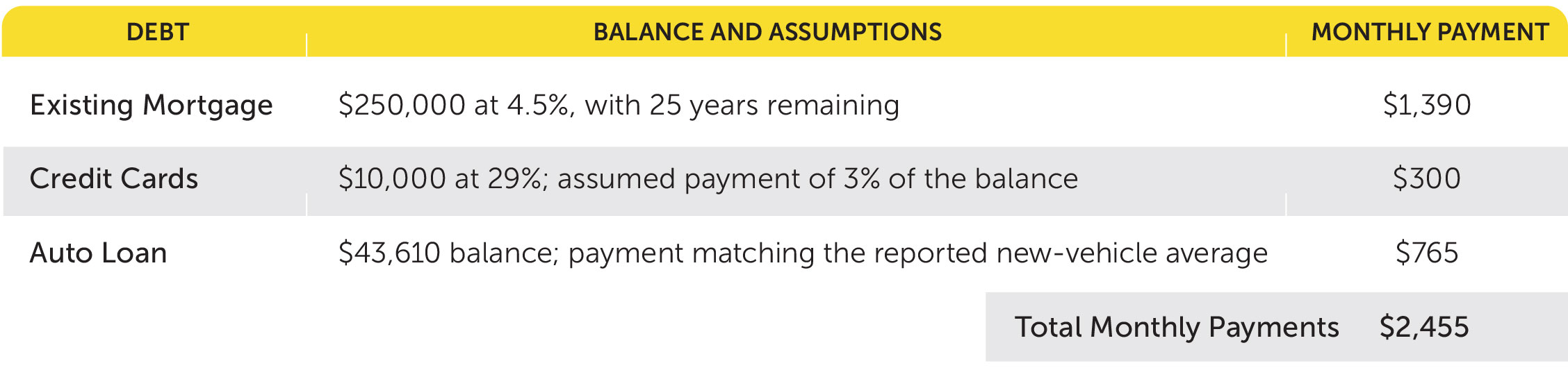
In this scenario, the homeowner is paying $2,455 each month toward these three debts.
The credit card balance presents a particular challenge. At 29%, a $10,000 credit card balance generates approximately $242 in interest during the first month, using a simplified monthly calculation. With a $300 payment, only about $58 initially goes toward principal, assuming no fees or additional purchases.
Now consider what might happen if the homeowner consolidated these debts through a cash-out refinance.
Suppose that homeowner qualifies for a $308,610 cash-out refinance at an illustrative 7% fixed interest rate for 30 years. The loan pays off all three balances, the existing mortgage, credit card balance, and auto loan and includes $5,000 in financed closing costs. For illustration purposes only, closing costs are assumed to be financed into the new loan balance.
Under these assumptions, the new monthly principal-and-interest payment would be approximately $2,053 per month, reducing initial combined payments by about $401 monthly, based on unrounded calculations.
The potential benefit is more room in the monthly budget and fewer separate payments to manage. However, this reduction is largely made possible by extending repayment over a longer period. The new loan also comes with a higher mortgage rate than the homeowner’s original loan.
Can You Use Home Equity if Your Mortgage Is Paid Off?
You don’t need an existing mortgage to explore the potential benefits of home equity. If you own your home outright, you may be able to borrow against its value to address other financial obligations.
According to the Census Bureau’s 2020–2024 estimates, approximately 39.4% of owner-occupied homes were mortgage-free. For homeowners carrying expensive consumer debt, borrowing against equity may offer a way to restructure payments and potentially improve monthly cash flow.
However, a paid-off home provides valuable security. A new mortgage creates an obligation secured by that home, so the benefit must justify the costs and risks.
Cash-Out Refinance vs. a Home Equity Loan or HELOC
A cash-out refinance is just one way to access your home equity. Depending on your current mortgage and financial goals, a home equity loan or HELOC may be worth considering, too.
Cash-out refinance
Replacing your existing mortgage with a new, larger loan. It may be worth exploring if you want to consolidate debt and your new mortgage terms make sense for your overall financial situation.
Home equity loan
Borrowing against your home equity while generally keeping your existing first mortgage. It may be worth exploring if you need a specific amount of money but want to preserve a favorable mortgage rate.
Home equity line of credit (HELOC)
Borrowing against your home equity through a flexible line of credit, similar to a credit card, while generally keeping your existing mortgage. It may be worth exploring if you want the ability to access funds as needed over time.
Each option has different costs, terms, and repayment structures. If you currently have a mortgage with a 4%–5% interest rate, comparing a home equity loan or HELOC against a cash-out refinance can be especially important. Keeping your existing mortgage may help you avoid replacing a low rate with a higher one.
The right choice depends on your current loan, how much you need to borrow, the rates and terms available to you, and how you plan to repay the debt.
Make the Monthly Relief Part of a Long-Term Plan
Lowering your monthly payments can make a meaningful difference in your monthly budget, but lower monthly payments could also lead to paying more over the life of your debt. There are some things to consider before making a move to restructure your debt.
Compare the total cost of borrowing
Closing costs, interest rates, and repayment terms all affect what you'll pay over time. In the example above, financing $5,000 in closing costs also increases the amount borrowed.
Consider the impact of a longer repayment period
Much of the payment reduction comes from extending repayment. An auto loan’s term is usually five to seven years. Spreading those balances over the life of a 30-year mortgage may reduce your monthly payment obligations, but you could pay more interest over the long term
Understand the risk to your home
Paying off credit cards with home equity also turns unsecured debt into debt secured by your home, creating foreclosure risk if mortgage payments cannot be maintained.
Plan to avoid accumulating new debt
Consolidation reorganizes what you owe; it doesn't erase it. If you pay off credit cards but continue to carry new balances, you could end up with both a larger mortgage and additional consumer debt.
Look Beyond Your Mortgage Rate
A low mortgage rate is valuable, but it’s only one part of your overall financial picture. If high-interest debt is putting pressure on your monthly budget, exploring your home equity options may help you identify a path forward.
A cash-out refinance could be worth considering, but it isn't the right fit for everyone. Comparing it with a home equity loan or HELOC can help you understand your options and determine which approach best aligns with your goals.
If you're considering using home equity to consolidate debt, reviewing your current debts, monthly obligations, and long-term financial goals can help you evaluate whether the potential benefits outweigh the costs and risks. A comprehensive review can help you evaluate potential savings, understand the trade-offs, and choose a strategy that works for your financial future.
Max Lucas
Mortgage Loan Officer | HAPO Community Credit Union
max.lucas@hapo.org